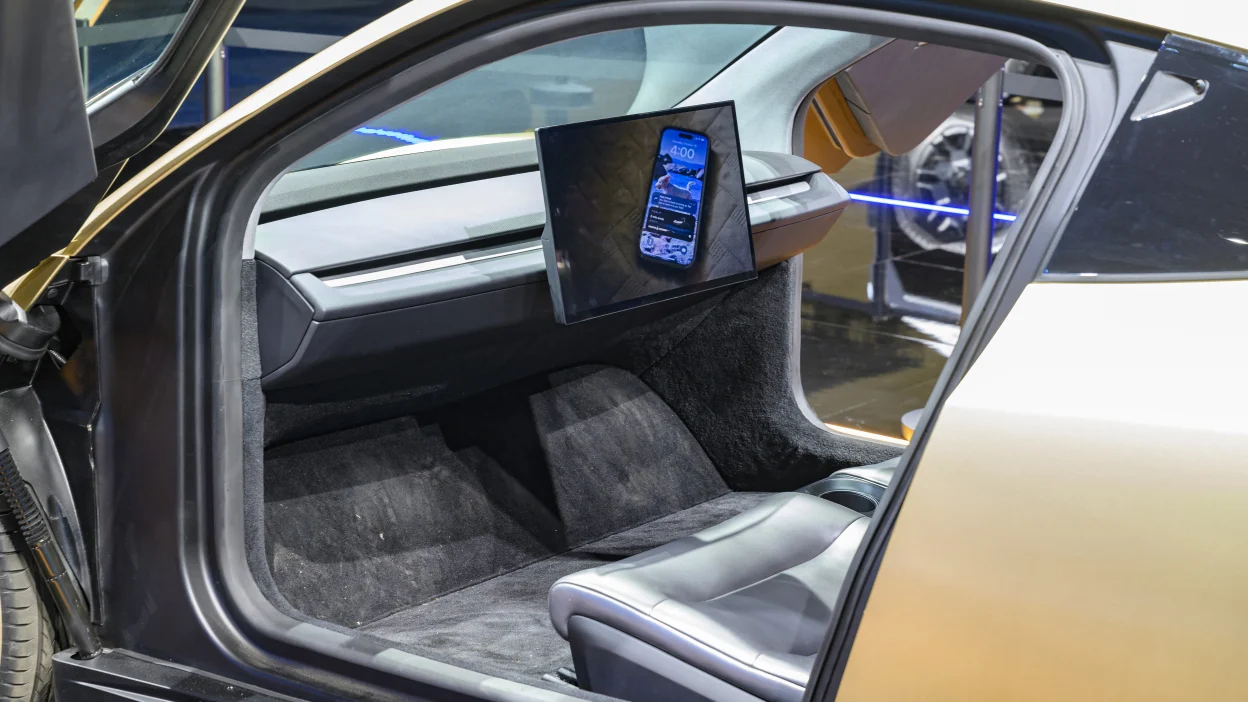
The first production Cybercab rolled off the line at Gigafactory Texas on February 17, 2026. No steering wheel. No pedals. No side mirrors. Just two seats, a stack of cameras, and an AI computer that makes all of that stuff unnecessary. Tesla didn't just build a new car they built a new way of building cars entirely.
Tesla Cybercab Production Timeline What's Actually Happening
Tesla is targeting volume production starting April 2026, with the wild internal goal of one Cybercab every 10 seconds at full scale roughly 2 million units per year. Musk has pegged the price at around $25,000, making it the most affordable purpose-built autonomous vehicle on the planet by a wide margin.
By early March, independent observers were documenting 25 Cybercabs across three locations at Giga Texas, with hundreds more in various build stages. The ramp is real. It's slow, as Musk himself warned it would be, but it's happening.
Cybercab sightings are already being logged across Texas and the Bay Area you can track the fleet as it grows on the Live Sightings Map.
The Unboxed Process Why This Manufacturing Method Is a Big Deal
Traditional car factories drag a hollow frame through a long sequential line paint shop, sub-assembly, interior, repeat. Tesla threw that playbook out. Their Unboxed manufacturing process builds five or six major modules in parallel: front end, rear end, structural battery pack, left and right side structures. Robots laser-weld and bolt them together in a final marriage step. Body panels go on last. The car never touches the ground until it's essentially done.
According to Tesla's Q1 2026 earnings call, the method cuts factory footprint by 40% and labor costs by 30% versus traditional linear assembly. The Cybercab also has roughly half the part count of a Model 3. Fewer parts means fewer failure points, cheaper service, and faster build times.
No Paint Shop Tesla Deleted an Entire Factory Department
This is the part that genuinely surprised the manufacturing world. The paint shop is normally the single largest contributor to factory size, toxic emissions, energy use, and process complexity in any automotive plant. Tesla just... removed it.
The Cybercab uses polyurethane body panels with color baked in during molding not sprayed on afterward. No toxic fluids. No curing ovens. No orange peel. No paint bleed. Tesla's VP of Engineering Lars Moravy put it plainly: they only coat things that actually need corrosion protection at this point.
Less factory space per unit of output means Tesla can build more Cybercabs in a smaller footprint than any competitor could match with conventional methods.
Cybercab Specs What You're Actually Getting
The vehicle itself is legitimately impressive on paper. A $25,000 autonomous two-seater with 5.5 miles per kWh efficiency, a 35 kWh battery, 200 miles of range, and wireless inductive charging at over 90% efficiency. No charging cable to plug in. You park it, it charges.
For context on what that efficiency number means: the Model Y Long Range does about 4.0 mi/kWh. The Cybercab beats it by 37% partly because it's lighter, simpler, and stripped of everything that isn't essential to moving two people from A to B.
The Robotaxi Math Why This Is a Different Business Model
Here's what makes the Cybercab financially interesting beyond the sticker price. A typical personal car sits parked about 95% of the time. A high-utilization robotaxi running in a fleet operates closer to 60–70% asset utilization. Stack that against a production cost that's already collapsing due to fewer parts and no paint shop, and the unit economics of the Cybercab fleet model start to look very different from traditional car sales.
The caveat and it's a real one is that Morgan Stanley's Adam Jonas has noted the gap between building a Cybercab and profitably operating one in a revenue-generating fleet could be substantial. Production in 2026 doesn't mean commercial deployment in 2026. That's more of a 2027–2028 story.
The Regulatory Reality The One Thing Tesla Can't Control
The Cybercab can't legally operate at scale in most states right now. Federal rules limit the number of driverless vehicles on public roads, and the SELF DRIVE Act of 2026 is still moving through Congress with bipartisan support but hasn't passed yet. Tesla chair Robyn Denholm was refreshingly pragmatic about it: if regulators require a steering wheel, the car can have one.
Musk's take is that regulatory approval will roughly pace with production. That's the bet. If regulators move slowly, Tesla has a factory churning out vehicles that can't carry passengers in most markets. If they move quickly, Tesla has a purpose-built fleet that no competitor can replicate at that price point.
For comparison: Waymo runs about 2,500 vehicles, all retrofitted existing models, at roughly three times the per-vehicle cost of a Cybercab. Tesla's advantage is cost and scale. Waymo's advantage is years of real-world driverless data and existing regulatory approvals. Tesla's current Austin robotaxi service still uses Model Ys with safety drivers not Cybercabs.
Curious how the Cybercab fleet is spreading city by city? Check the City Leaderboard to see where sightings are concentrating.
What to Watch the Rest of 2026
Three things will tell the story. First, whether production actually scales from tens of units per day in April to 1,000 units per week by mid-year and 5,000 per week by year-end. Second, whether the SELF DRIVE Act passes and federal regulators certify the vehicle for driverless operation. Third, whether Tesla can demonstrate sustained unsupervised autonomous trips at commercial scale.
Tesla's stock in 2026 will likely track those three variables more than anything else in the market. The manufacturing innovation is real. The vehicle is real. The revenue story is still being written.
Track every Cybercab spotted in the wild → Live Sightings Map
🚗⚡