How Tesla builds a robotaxi in modules, with about 25 automated final-assembly stations, no paint shop, and a line that is currently faster than the fleet. A plain-English guide to the Munro Live walkthrough.
Munro Live took a camera onto the Cybercab line at Giga Texas and sat down with Tesla's vehicle engineering team, including Lars Moravy, to walk through how the car is built. It runs close to 90 minutes and it is the best look at the unboxed process we have seen. This page turns it into a quick reference, and we will keep it current as Tesla shares more.

Thank you to the Munro Live team for the walkthrough and for pushing the engineers on the details. Watch the full video, then subscribe to the channel for more deep dives.
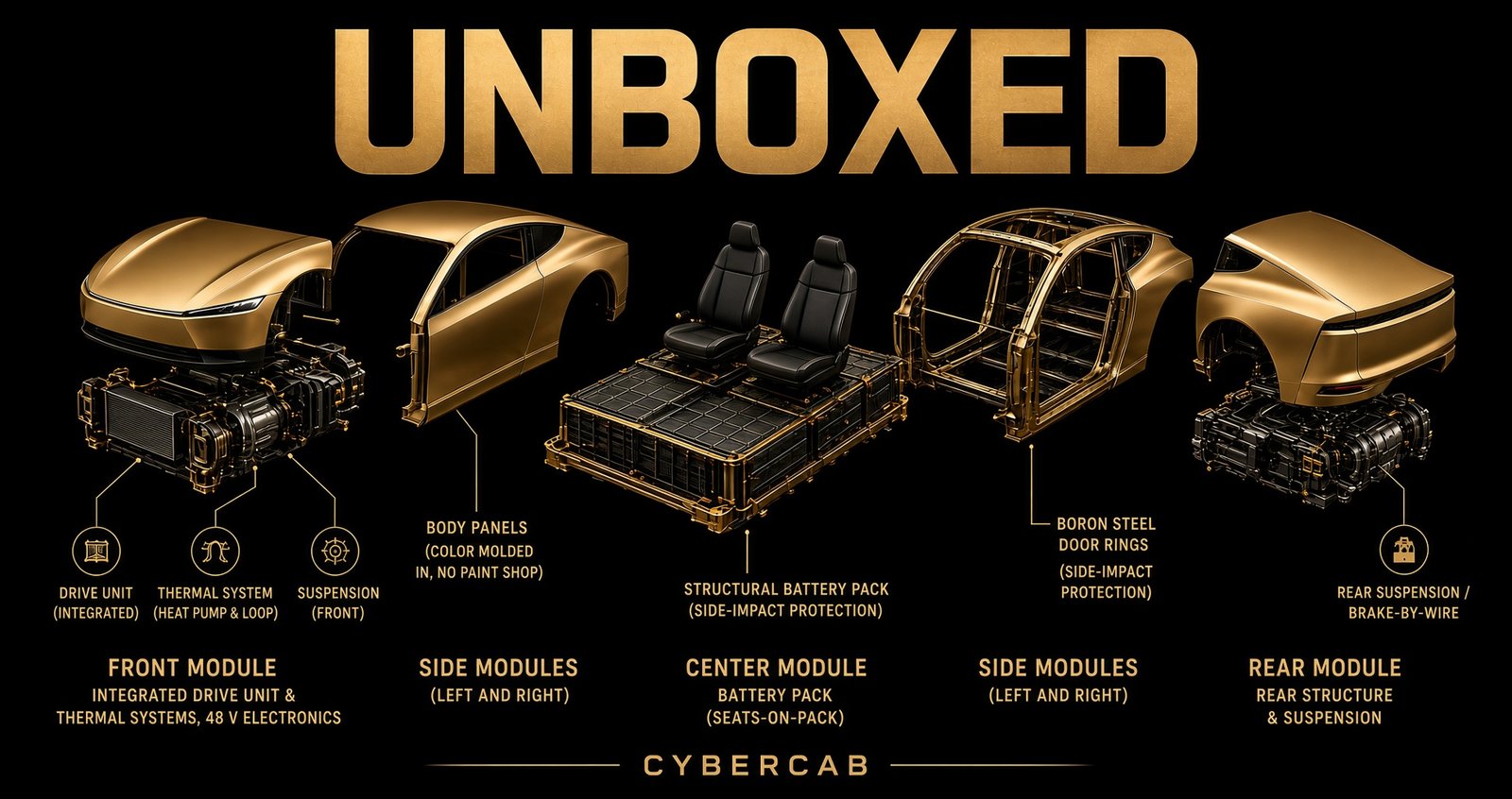
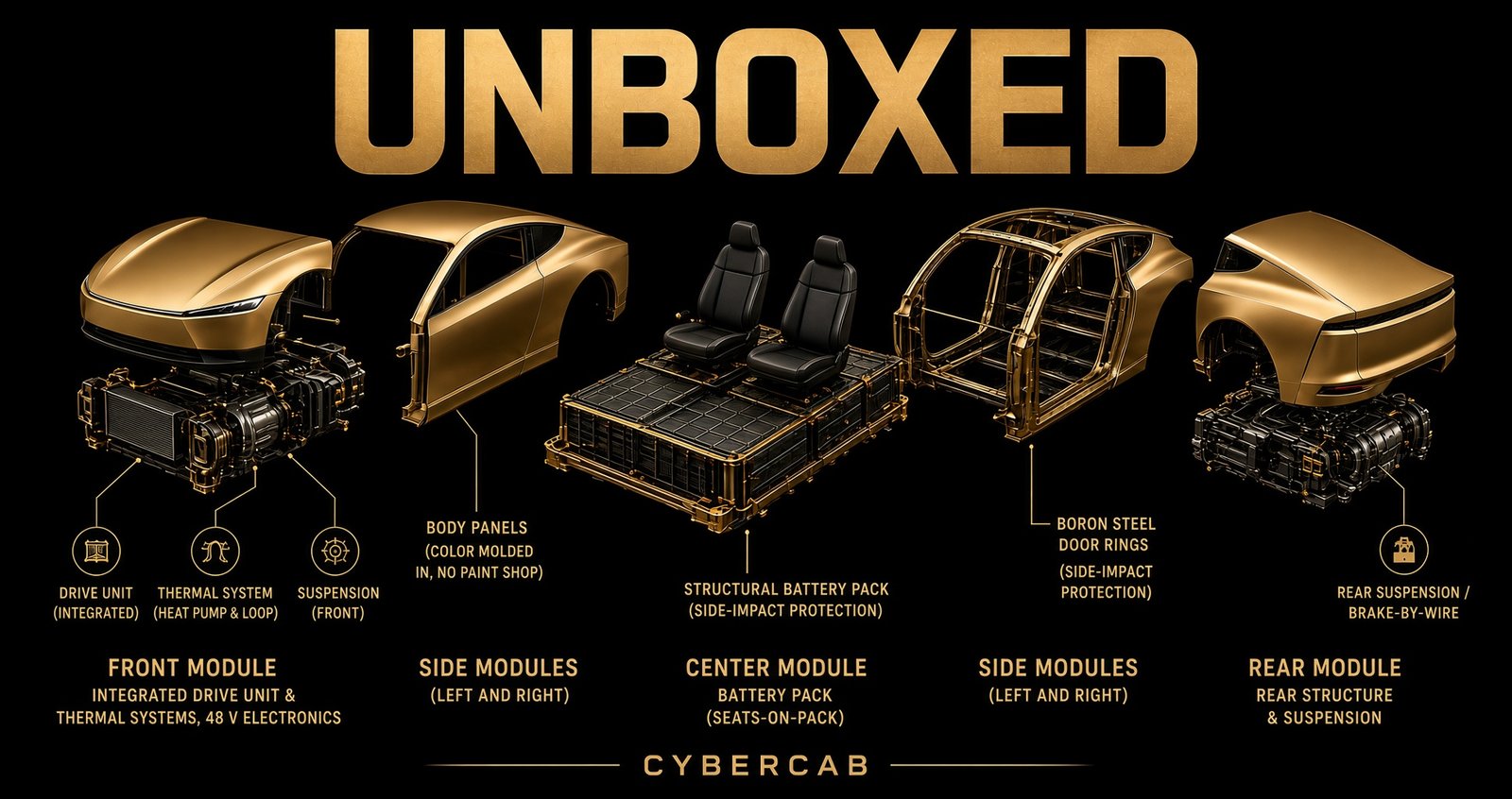
A traditional car plant is one long line: a body shell goes in at one end and parts get added in order until a finished car comes out the other. The unboxed process splits the car into separate modules (front, two sides, rear, and a center section with the seats mounted on the battery). Each module is assembled and tested on its own, then they join late in the flow. Tesla first described the idea publicly in a September 8, 2026 post saying it cuts the line size in half (TeslaNorth).
Smaller pieces are easier for robots to reach from every side, they keep people from climbing inside a half-built body, and a defect shows up on the bench instead of at the end of the line. The engineers also stressed that design, manufacturing, and automation work in one group, so a part gets designed to be built.
Roughly half of the car's parts sit up front: the drive unit, the thermal system, the low-voltage electronics, and the 48-volt architecture. Grouping them keeps wiring short and lets Tesla build and self-test the whole module before it ever meets the rest of the car, so it arrives already communicating. Service access was a design goal too, with the inverter reachable without dropping the suspension.
The Cybercab uses full brake-by-wire: an electric actuator at each wheel, with no master cylinder and no brake fluid. That is what makes the modular build possible, because you cannot run a closed hydraulic circuit across modules that are built separately. It also has steer-by-wire, a 48-volt low-voltage system, and a motor Tesla says uses no rare earth metals (EVwire).
The sides are single-piece door rings designed for crash protection. Because each ring is its own module, it can be built flat on a bench instead of inside a finished body.
For a robotaxi, the cost that matters is cost per mile over a long life, so the pack is designed around serviceability. As described in the walkthrough coverage, the pack's top cover doubles as the cabin floor (seats mount straight to it), individual modules are replaceable so one failure does not scrap a whole pack, and the battery management uses wireless connections to remove harnesses. There is also room to fit a lower-cost LFP chemistry later without redesigning the pack.
The thermal system is a third-generation heat pump (the "Supermanifold" V3) that is built, filled, and leak-tested on a pallet before it goes into the car. Most of the complexity moved to the coolant side so the refrigerant side can stay a sealed system. The front-wheel-drive unit is tuned for efficiency rather than top speed, which suits a vehicle that spends its life in city traffic. Lars Moravy and the team described it as the most efficient EV Tesla has built.
Body panels are injection-molded with the color built into the material, so there is no traditional paint shop. Deleting it is one of the biggest single contributors to the smaller footprint and lower cost. Final assembly is the short automated line where the pre-tested modules come together. The wheels go on at the second-to-last station, so the first time a Cybercab sits on its own wheels is when it rolls off the line.
Last reviewed October 26, 2026. "Tesla / reported" means Tesla or major coverage has stated it. "Walkthrough notes" means it comes from tour coverage and has not been confirmed in a Tesla spec sheet.
| Item | Detail | Source |
|---|---|---|
| Architecture | Unboxed modular: front, sides, rear, seats-on-pack center | Tesla / reported |
| Final assembly | ~25 fully automated stations | Tesla / reported |
| Line automation | ~78% today; goal 100% with a 10-second cycle | Tesla / reported |
| Floor space | ~50% less per vehicle | Tesla / reported |
| Brakes and steering | Full brake-by-wire and steer-by-wire | Tesla / reported |
| Low-voltage system | 48 V | Tesla / reported |
| Body | Injection-molded panels, color in the material, no traditional paint shop | Tesla / reported |
| Battery layout | Reported 88S6P, 4680 cells, modular and serviceable, LFP-ready | Walkthrough notes |
| Battery capacity | ~48 kWh (estimate) | Walkthrough notes |
| Drive unit | Front-wheel drive, 5DU, ~11:1 gear ratio | Walkthrough notes |
| Curb weight | ~3,113 lb (EPA filing) | EPA / reported |
| Power | ~219 hp (EPA filing) | EPA / reported |
| Target life | 500,000+ miles | Walkthrough notes |
For the full numbers see our Cybercab specs page.
Lars Moravy said Tesla does not run the line every day because it is currently outpacing deployments (TeslaNorth). Tesla can build Cybercabs faster than it can put them to work, and that is why cars show up staged and spotted in places that do not have service yet. Texas records show 463 Cybercabs registered, according to Drive Tesla Canada.
Tracking that gap is our job. Here is how to follow the rollout on MyCybercab:
Add it to the map and help the community track exactly where the fleet is showing up.